
Wudu
The basic form of purification for prayer is called Wudu ’ (ablution).
Islam is a faith built on purity — purity in one’s body, clothing, and surroundings, and purity in one’s heart and soul. It calls for cleanliness from physical impurities and cleansing from sins, harmful character traits, and corrupt intentions.
Allah says: O you who believe, when you rise up for prayer, wash your faces, and your hands up to the elbows; wipe over your heads; and wash your feet up to the ankles. If you are in a state of major impurity, cleanse yourselves [by taking a bath]. But if you are ill, on a journey, or have relieved yourselves, or had sexual contact with women and find no water, then purify yourselves with clean earth, and wipe your faces and hands therewith. Allah does not want to impose hardship on you, rather He wants to purify you and complete His favor upon you, so that you may be grateful. [Surat al-Mā’idah: 6]
Prayer is a private conversation between the slave and his Lord. Therefore, when standing before his Lord, a Muslim must be in his best state in terms of purity, cleanness, and humility. For this reason, Allah has made it obligatory upon the Muslimwho wants to pray to purify himself, his clothes, and the place of his prayer from all types of impurities and ritual impurity
Merits of Wudu
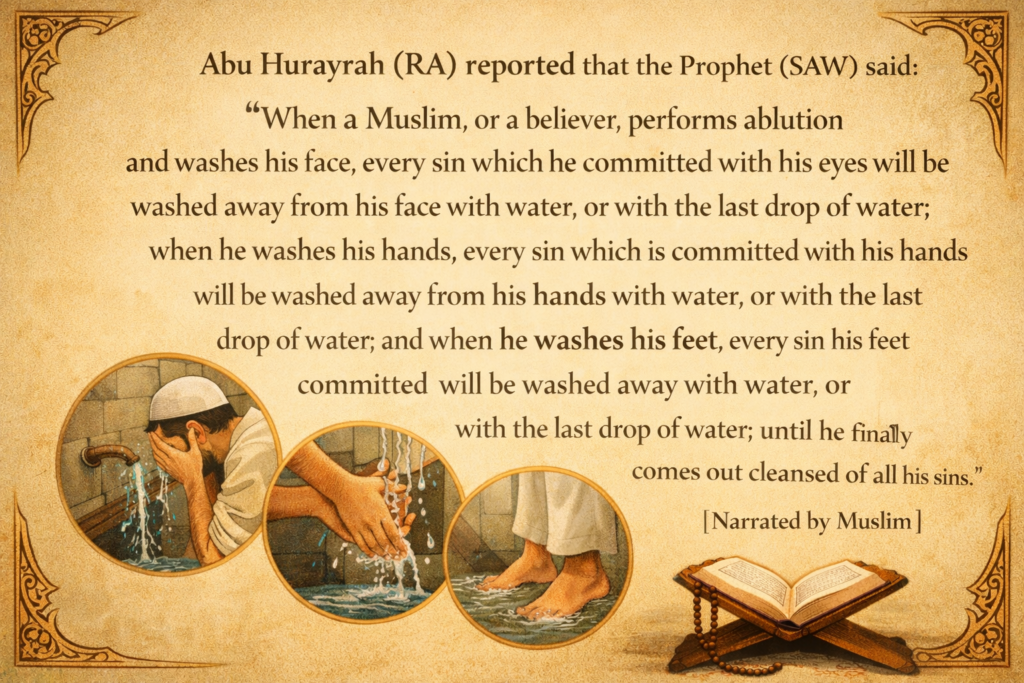
Wudū’ (ablution) has many great merits, for it is half of Imān (faith) and a means by which Allah Almighty erases sins and elevates degrees. It is also one of the reasons for being admitted to Paradise and it is light for the Muslim on the Day of Judgment and a cause for untying the devil’s knots.
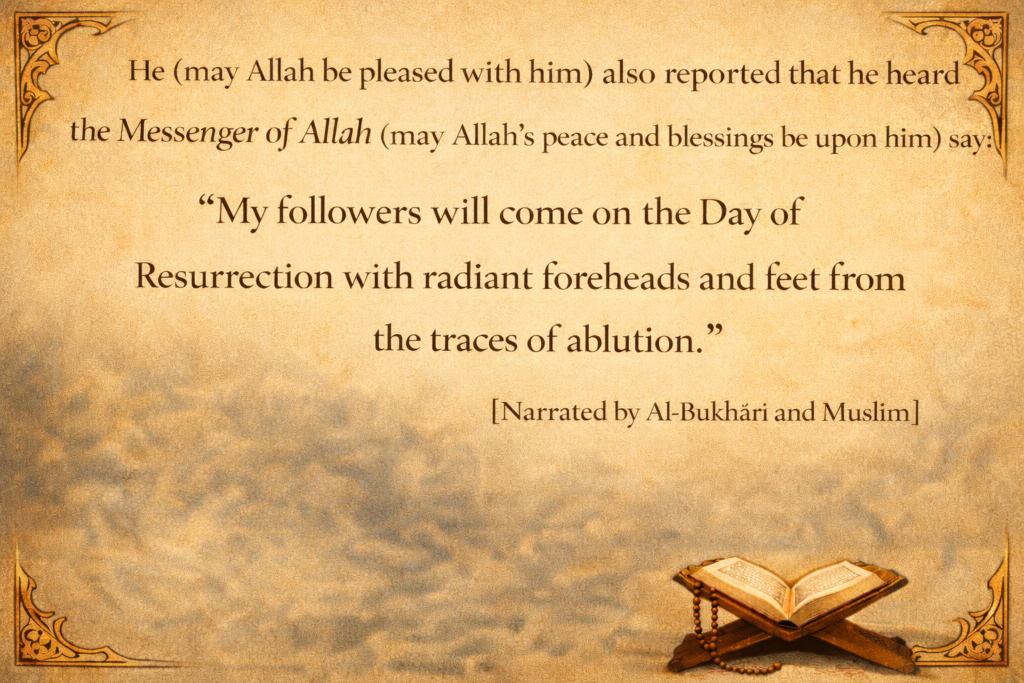
Moreover, it is a special sign of this Ummah (the Muslim nation) on the Day of Judgment, as Muslims shall come on that day with radiant foreheads and feet and with their faces, hands, and feet radiating light from the traces of ablution.
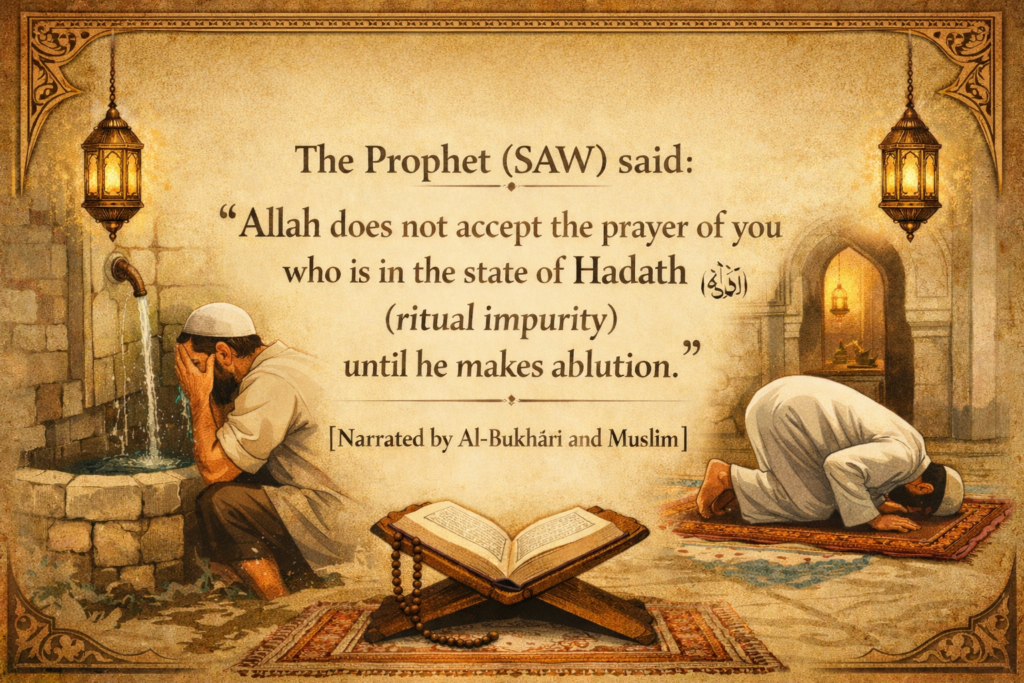
The one who prays must first be purified from minor and major Hadath (ritual impurity) and from material impurity, as clarified by the following:
Hadath: It is an abstract description existing in the body, which prevents prayer. It is divided into two categories, which are:
Minor Hadath: It occurs because of urinating, defecating, passing wind, or sleeping. This kind of Hadath is removed by making ablution (wudu).
Major Hadath: It is called Janābah. It occurs because of sexual intercourse or the discharge of semen. It is removed by taking a bath and washing the whole body with water.
Najas: It means the material filth like urine, stool, and running blood. It is removed by washing it with water until it disappears.
Passing urine is called “Hadath”, whereas the urine itself is called “Najāsah”.
The one who performs prayer must be purified from all types of Hadath and Najāsah. So, if he is in the state of minor Hadath (minor ritual impurity), he must perform ablution. However, if he is in the state of major Hadath (major ritual impurity), he must take a bath.
How to Perform Wudū’ (Ablution)
- Ablution is not complete without intention. Intention is not complete without sincerity. The place of intention is one’s heart, not his tongue.
- Sequent washing ablution members in order is required. It is not right to ignore this order or delay washing its members.
1. Niyyah (intention):
Have the Niyyah.
i.e. intend with the heart without uttering it, to perform ablution for removing Hadath and the like. Ablution is not valid without intention like the one who intends to wash his organs without recalling the intention of worship, and we must do this with full sincerity to Allah Almighty.
2. Tasmiyah (saying Bismillah: In the name of Allah):
It is prescribed to make Tasmiyah at the beginning of the ablution by saying: “Bismillāh” (In the name of Allah).
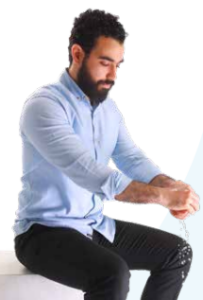
3. Washing the hands:
Wash both hands to the wrist three times, starting with the fingertips to the palm joint.
Make sure no part of your hands is left dry.
4. Rinse the mouth
Rinse mouth thoroughly using water with your right hand and clean the nose with your your left hand.
5. Clean the nose
Take water with the right hand and sniff it into the nostrils. Blow the water out of the nose using the left hand.
6. Wash the face
Wash the face completely and ensure no part is left dry.
The facial boundary extends lengthwise from the natural hairline down to the end of the chin, and breadthwise from one ear to another. It is necessary to wash all the facial hair including the light beard hair, the mustache, the eyebrows, the eyelashes, and the hair that grows below the lower lip.
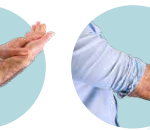
6. Wash the hands to the elbow
Start by washing the right hand from the fingertips, and wash between the fingers by entwining the palms, then let the water reach the elbow and do the same with the left hand.
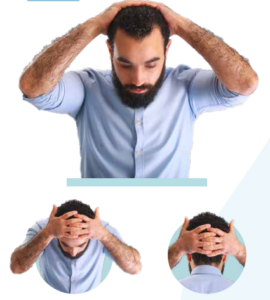
7. Wipe over the head
Wet both hands with fresh water, then put those wet hands on the front of the head and move them backward until reaching the nape, then move them forward until reaching the place from where you started.
There is no difference here between the bald and the one who has hair.
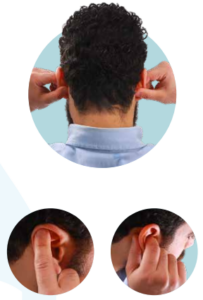
8. Wipe the ears
Wipe both ears with what is left of the water used for wiping over the head. This should be done by putting the forefinger inside the ear and wiping it and wiping over the outside with the thumb. By this, you wipe the ears from the outside and inside. Wiping over the head along with the ears is to be done once.
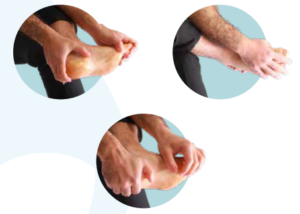
9. Washing the feet
Start by washing the right foot from the tiptoes to the ankles, which refer to the two prominent bones on both sides of the leg connecting the shin to the foot, washing between the toes, and
carefully washing the heel, which is the rear of the foot, in addition to washing the outward part of the foot. Then, wash the left foot in the same manner as washing the right foot.





NOTES:
- Wiping over the head along with the ears should be done once only, as for the remaining acts of ablution, they are to be repeated three times, which represents perfection, or two times, or once, which is an obligation.
- Observing the prescribed order in washing the body parts in ablution is required; thus, no part should precede the other in order.
- Also observing the prescribed succession is required; so, there should be no long interval
between washing one part and washing the part that succeeds it.
It is Sunnah for the Muslim to say the following after completing the ablution:
“Ash-hadu allā ilāha illallāh wahdahu lā sharīka lah, wa ashhadu anna Muhammadan ‘abduhu wa rasūluh”
(I testify that there is no god but Allah Who has no partners, and I testify that Muhammad is His slave and messenger).
He may add the following: “Allāhumma ij‘alni min attawwābīn waj‘alni min al-mutatahhirīn”
(O Allah, make me of those who constantly repent and those who constantly purify themselves).
Or:
“Subhānak allāhumma wa bihamdik, ash-hadu allā ilāha illa ant, astaghfiruka wa atūbu ilayk”
(Glory and praise be to You, O Allah. I testify that there is no god but You. I seek Your forgiveness and I repent to You).