5 Pillars of Islam
The Foundation of a Muslim’s Faith and Practice
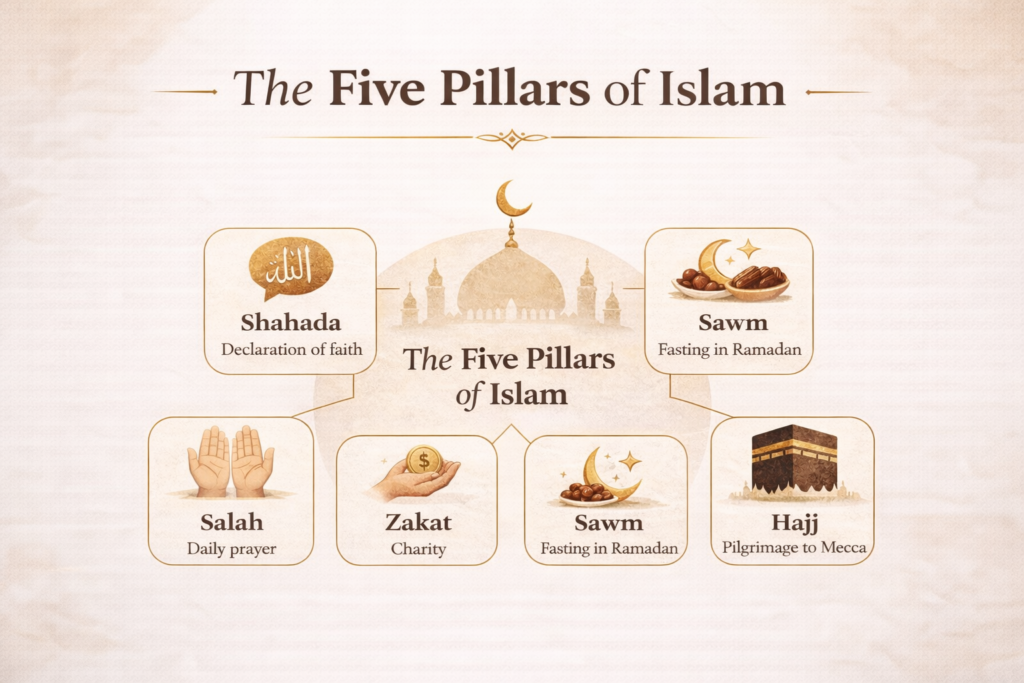
Islam is a complete way of life built upon clear foundations known as the Five Pillars of Islam. These pillars are the essential acts of worship that define a Muslim’s relationship with Allah and guide their daily conduct, spirituality, and responsibilities toward others.
“On the authority of Abdullah ibn Umar ibn Al-Khattab (may Allah be pleased with him) who said: I heard the Messenger of Allah (peace be upon him) say:
Islam has been built on five [pillars]: testifying that there is no god but Allah and that Muhammad is the Messenger of Allah, performing the prayers, paying the Zakah, making the pilgrimage to the House, and fasting in Ramadan.- [Bukhari & Muslim]
These pillars are practical obligations that nurture faith (īmān), discipline the soul, and create a balanced, just society.
1. Shahādah – The Declaration of Faith
The Shahādah is the foundation of Islam and the gateway into the faith. It is the sincere declaration:
“There is no deity worthy of worship except Allah, and Muḥammad ﷺ is the Messenger of Allah.”
By affirming the Shahādah, a person testifies to the Oneness of Allah (Tawḥīd) and accepts the message brought by Prophet Muḥammad ﷺ. This declaration must be made with conviction and is reflected through obedience, worship, and adherence to Allah’s guidance.
Allah says in the Qur’an:
“So know that there is no god worthy of worship except Allah…”
(Qur’an 47:19)
The Shahādah is not merely spoken once—it is a lifelong commitment that shapes belief, worship, and character.
2. Ṣalāh – Establishing the Five Daily Prayers
Ṣalāh (prayer) is the daily act of worship that maintains a constant connection between the believer and Allah. Muslims are required to perform five obligatory prayers each day at prescribed times.
Prayer instills discipline, humility, and mindfulness of Allah throughout the day. It is both a spiritual nourishment and a moral safeguard.
Allah says:
“Indeed, prayer has been decreed upon the believers at prescribed times.”
(Qur’an 4:103)
The Prophet ﷺ emphasized its importance:
“The first matter that the servant will be brought to account for on the Day of Judgment is the prayer.”
(Sunan al-Tirmidhī)
Ṣalāh is the pillar that sustains faith. When prayer is established, the rest of a believer’s life begins to align with righteousness.
3. Zakāh – Obligatory Charity
Zakāh is a compulsory act of worship for Muslims who possess wealth above a specified threshold (niṣāb). It purifies wealth and ensures that society’s most vulnerable are cared for.
Zakāh is not optional charity; it is a right owed to those entitled to receive it, such as the poor, the needy, and others specified in Islamic law.
Allah says:
“Take charity from their wealth to purify and cleanse them.”
(Qur’an 9:103)
The Prophet ﷺ said:
“Charity does not decrease wealth.”
(Ṣaḥīḥ Muslim)
Through Zakāh, Islam cultivates generosity, social responsibility, and compassion, reminding believers that all wealth ultimately belongs to Allah.
4. Ṣawm – Fasting in the Month of Ramaḍān
Ṣawm (fasting) during the month of Ramaḍān is obligatory for every adult Muslim who is able. From dawn until sunset, Muslims abstain from food, drink, and marital relations, while also striving to control speech, thoughts, and behavior.
The purpose of fasting is to develop taqwā (consciousness of Allah).
Allah says:
“O you who believe, fasting has been prescribed for you as it was prescribed for those before you, that you may attain taqwā.”
(Qur’an 2:183)
The Prophet ﷺ said:
“Whoever fasts Ramaḍān with faith and seeking reward, his previous sins will be forgiven.”
(Ṣaḥīḥ al-Bukhārī, Ṣaḥīḥ Muslim)
Fasting trains the soul in patience, gratitude, and empathy, strengthening self-control and spiritual awareness.
5. Ḥajj – Pilgrimage to the Sacred House
Ḥajj is the pilgrimage to the Sacred House in Makkah and is obligatory once in a lifetime for Muslims who are physically and financially able.
Ḥajj is a profound act of worship that symbolizes unity, humility, and complete submission to Allah. Pilgrims from all backgrounds gather as equals, dressed simply, responding to Allah’s call. Ḥajj reinforces the global brotherhood of Islam and reminds believers of the Day they will stand before Allah.
Allah says:
“And [due] to Allah from the people is a pilgrimage to the House—for whoever is able to find a way.”
(Qur’an 3:97)
The Prophet ﷺ said:
“An accepted Ḥajj has no reward except Paradise.”
(Ṣaḥīḥ al-Bukhārī)